
The Indian to whom I owed my life a second time, and who had braved the wrath of the fiends to snatch me from a death, in comparison to which all others pale into insignificance, the tried friend, whose friendship stood as a shield between me and petty persecution during my captivity, I shall ever hold in grateful remembrance.  To him I owe the only hours of contentment that were vouchsafed me during seven years of existence; seven long years of toil and mental anguish. How can I picture to the imagination of my readers the noble qualities of head and

heart with which this child of nature was endowed? He was a rough diamond, and it was only by the attrition of constant intercourse that his best qualities displayed themselves. Physically he was perfect; his movements were instinct with that grace and ease that are the attributes of those alone whose lives have been spent in the cultivation of all exercises that look to the development of the muscles.
How vividly his image presents itself to my mind as I write; his body, which was nude to the waist, except on occasions, when religious observances demanded peculiar attire, was streaked most fantastically with different colored pigments. The head-dress, that consisted of two war eagles' plumes, one dyed vermilion, the other its natural hue, served only the more to distinguish a head that would have been conspicuous in any company.
Suspended from his neck by a massive chain hung a disc of beaten gold, on which was rudely engraved the figure of a tortoise, the symbol of priesthood. Pendants of gold depended from either ear, and his arms were encircled above the elbow with broad gold bands. The limbs were encased in leggings of dressed fawn skin, ornamented along the seams with a fringe of scalp-locks; a guarantee of his personal bravery. Moccasins worked into grotesque designs with beads and porcupine quills covered his feet. Pervading all like an intangible essence was that ever present frank bearing and dignified courtesy, that at once marked him as a chieftain and ruler among [men. Such was the medicine man of the Camanches and the high-priest Quetzalcoatl, Wakometkla
.
To him I owe the only hours of contentment that were vouchsafed me during seven years of existence; seven long years of toil and mental anguish. How can I picture to the imagination of my readers the noble qualities of head andheart with which this child of nature was endowed? He was a rough diamond, and it was only by the attrition of constant intercourse that his best qualities displayed themselves. Physically he was perfect; his movements were instinct with that grace and ease that are the attributes of those alone whose lives have been spent in the cultivation of all exercises that look to the development of the muscles.
How vividly his image presents itself to my mind as I write; his body, which was nude to the waist, except on occasions, when religious observances demanded peculiar attire, was streaked most fantastically with different colored pigments. The head-dress, that consisted of two war eagles' plumes, one dyed vermilion, the other its natural hue, served only the more to distinguish a head that would have been conspicuous in any company.
Suspended from his neck by a massive chain hung a disc of beaten gold, on which was rudely engraved the figure of a tortoise, the symbol of priesthood. Pendants of gold depended from either ear, and his arms were encircled above the elbow with broad gold bands. The limbs were encased in leggings of dressed fawn skin, ornamented along the seams with a fringe of scalp-locks; a guarantee of his personal bravery. Moccasins worked into grotesque designs with beads and porcupine quills covered his feet. Pervading all like an intangible essence was that ever present frank bearing and dignified courtesy, that at once marked him as a chieftain and ruler among [men. Such was the medicine man of the Camanches and the high-priest Quetzalcoatl, Wakometkla
.
With returning consciousness, I found myself extended along the sward, the Indian kneeling by my side and holding in the palm of his hand some crushed bark, of a peculiarly pungent and aromatic odor. Clustered around me were a group of savages, who, judging by their menacing looks and excited gestures were not wholly pleased with the new turn which affairs had taken.
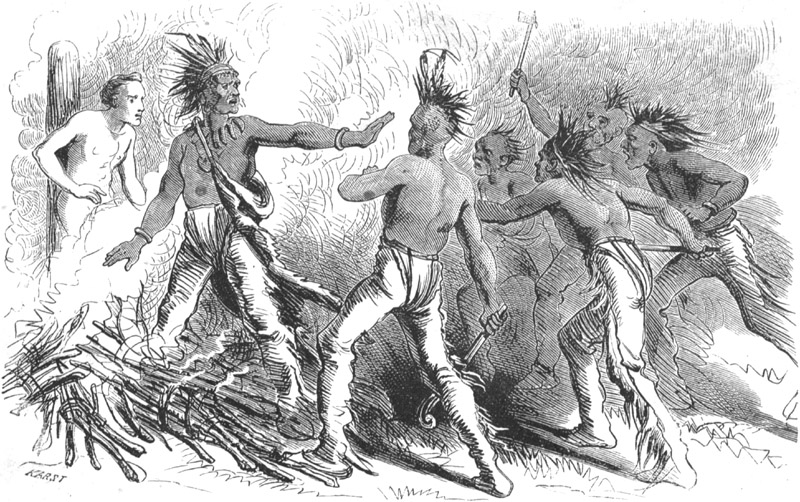
One among them, emboldened perhaps by the unconcern of the chief, approached more nearly, and unsheathing his knife, raised the long, glittering, and murderous looking blade in mid air, preparatory to burying it hilt deep in my unresisting body. In a moment Wakometkla was on his feet, his proud form dilating with wrath. Grasping the culprit by the throat, he hurled him from him with tremendous force, sending him reeling through the crowd and to the ground; then turning to those that remained, he administered a sharp rebuke and motioned them away; they dispersed without delay, leaving me alone once more; the priest, meantime having entered the temple.
I could distinctly hear the crackling of the fagots and the agonizing wail of some poor victim, as the greedy flames, leaping higher and higher devoured his quivering flesh. Intermingling with the groans of the dying captives could be heard the triumphant yells of the blood-thirsty savages, which were echoed by the women that everywhere

filled the terraces of the lodges and temple; their bright-hued robes forming a striking contrast with their dark complexions.
Over this scene of butchery shone the sun, which had now reached its zenith, in all its unclouded brilliancy; the mountainous walls of milky quartz that enclosed the valley, catching his beams and reflecting them in myriad prismatic hues, that gave one the impression that he was in some enchanted domain.
One among them, emboldened perhaps by the unconcern of the chief, approached more nearly, and unsheathing his knife, raised the long, glittering, and murderous looking blade in mid air, preparatory to burying it hilt deep in my unresisting body. In a moment Wakometkla was on his feet, his proud form dilating with wrath. Grasping the culprit by the throat, he hurled him from him with tremendous force, sending him reeling through the crowd and to the ground; then turning to those that remained, he administered a sharp rebuke and motioned them away; they dispersed without delay, leaving me alone once more; the priest, meantime having entered the temple.
I could distinctly hear the crackling of the fagots and the agonizing wail of some poor victim, as the greedy flames, leaping higher and higher devoured his quivering flesh. Intermingling with the groans of the dying captives could be heard the triumphant yells of the blood-thirsty savages, which were echoed by the women that everywhere
filled the terraces of the lodges and temple; their bright-hued robes forming a striking contrast with their dark complexions.
Over this scene of butchery shone the sun, which had now reached its zenith, in all its unclouded brilliancy; the mountainous walls of milky quartz that enclosed the valley, catching his beams and reflecting them in myriad prismatic hues, that gave one the impression that he was in some enchanted domain.
The priest soon returned accompanied by a young girl, who bore in her arms a quantity of roots and strips of long bark, and placing them on the ground at my feet commenced applying them, first the leaves, then the bark, to my limbs. Soon I was swathed and bandaged like a mummy; which operation being performed, I was taken in their arms and carried inside the temple
.
.
Descending a ladder we entered a darkened chamber, the walls of which were hung with robes and curious devices; passing through this room I was conducted to an inner apartment which was partitioned off by a curtain of buffalo robes. In the corner of this room was a couch on which I was placed. After giving the girl some brief directions, the priest left us, the girl following him, after having brought me an earthen vessel filled with a dark liquid, which I understood by her gestures I was to drink. Such was the magical effect of the leaves in which my burned limbs were bound, that I no longer felt any pain, and
taking a deep draught of the liquid, I was soon asleep
.
taking a deep draught of the liquid, I was soon asleep
.
I must have slept many hours, for on awakening I found that it had grown quite dark, the only light being supplied by a small bluish flame that was dimly burning on a tripod in the center of the room. My attention was attracted by the peculiar furniture—if such it might be called—of this strange place.
The walls are hung with hideous shapes and skins of wild beasts; in which ever way I turn, I am attracted by odd shapes, such as the fierce visage of the grizzly bear, the white buffalo and panther; while interspersed among the horns of the cimmaron, elk and bison, are grim idols carved from the red claystone of the desert. All these, I feel sure, are the symbols of a horrid and mystic religion.
The fumes of the charcoal begin to affect me, my head grows hot; the pulse beats quicker; I fancy I hear strange noises; I think there are animals moving on the stone pavement; the fitful flame discloses a shining object, whose sinuous and gliding movements betrays the presence of the dreaded crotalus; it approaches my bed; its bead-like eyes glittering with a baleful light
.
My terror and excitement have now become agonizing; the veins stand out upon my forehead like whip cords; I am bathed in a cold perspiration. Making a mighty endeavor, I free my feet from the thongs that bind them, and springing from the bed, rush wildly towards the center of the room.
Once the sacred fire is reached, I can partially protect myself by scattering the glowing coals on the floor, and fight the reptiles with what they dread the most. In leaving the couch my foot becomes entangled, I give a sudden jerk, and to my horror and dismay, pull down a section of the fur-covered wall; a sight discloses itself that curdles the blood in my veins and thrills my frame with a paralyzing honor.
I have disturbed a nest of huge serpents! They move; uncoil themselves, and join the crotalus; suddenly the room seems alive with the venomous creatures. I hear the dreaded rattle and the sibilant hiss; rushing toward the fire, I seize the tripod and dash it to the ground, scattering the glowing embers in every direction. My fright becomes terrible, and I imagine the monsters are crawling over my body. With the frenzy of despair I rush to the door that leads out of this chamber of horrors, all the while uttering the most fearful shrieks. In a twinkling I am confronted by Indians, bearing lighted torches; taking in the situation at a glance, they enter the apartment, chase the serpents back to their hiding places, while I am hurried away to less disagreeable quarters. I have passed through many thrilling adventures, but for unparalleled horror, this one was without its peer.
The following morning, I was taken into the presence of the priest. That something of unusual moment was about to transpire, I felt sure, from the general air and appearance of those in the room.
Wakometkla was seated on a throne, around him were grouped a number of chiefs in all the bravery of war paint, plumes and robes. It was the council chamber, and I was about to go through the ceremony of adoption into the tribe. It might have been interesting had I understood their tongue, but as it was, I played the part of a puppet.
Wakometkla was seated on a throne, around him were grouped a number of chiefs in all the bravery of war paint, plumes and robes. It was the council chamber, and I was about to go through the ceremony of adoption into the tribe. It might have been interesting had I understood their tongue, but as it was, I played the part of a puppet.
The profoundest silence reigned throughout the apartment, and the gray dawn, stealing in through the door of the lodge, pervaded the room and made it colder and more desolate than before. A chief advanced to my side, and muttering something in which I could only distinguish the words "Americano" and "Quetzalcoatl," led me to the foot of the dais. Wakometkla arose and addressed me at length; then the warriors formed in a circle and moved around me, accompanying their movements with a wild sort of chant.
A young boy and girl, standing on one side supplied the music, using for this purpose an Indian drum, which produced a monotonous but rhythmic sound. This ceremony over, I am again led out and my clothes stripped from my back; substituting in their stead leggings and moccasins only. My body is then besmeared with paint and oil. My hair is shaved with scalping knives, leaving only a small ridge on my head, that ran from my forehead to my neck. Thus disguised and regenerated, I am again led into the presence of the chief, who embraces me, and waving his arm a young warrior advances with a
necklace, shield, bow and quiver, tomahawk and lance; these are given to me in addition to a tobacco pouch filled with k'neck k'nick, the Indian substitute for tobacco.
Thus accoutered, I am once more placed in the center of a circle, this time outside of the lodge; a small piece of turf is removed and the savages again commence their incantations. The dance is exceedingly grotesque, and consists of a series of yells, jumps and jarring gutterals, which are sometimes truly terrifying. Every step has its meaning, and every dance its peculiar song. When one becomes fatigued by the exercises, he signifies it by bending quite forward and sinking his body towards the ground, then withdraws from the circle; when all have retired in this manner the dance is ended, and all that remains to make me one of them is branding.
During these ceremonies, I often wondered why I should have been singled out for adoption, when there were others who would, in my opinion have answered their purposes so much better; the Mexicans, for instance, with whose language they were familiar, would have been more serviceable; again, why should they take anyone into the tribe?
Later, all this was explained. It seems that the medicine man is averse to initiating any of his own people into the secrets and hocus-pocus of his art, as the apprentice, with the knowledge thus gained, might in time become a formidable rival. By adopting a captive this risk is obviated, as under no circumstances could he aspire to
the honors of priesthood. In the event of his escape, the only damage would be the loss of an experienced assistant. From this time I was always addressed by my new name Tah-teck-a-da-hair (the steep wind), probably from the fact that I outstripped my pursuers in my vain effort at escape. I was allowed to roam at will through the village, but I noticed that wherever I went, watchful eyes followed my every motion.
I was actuated in my rambles solely by the desire to see my wife; vain effort. I entered lodge after lodge, climbed from terrace to terrace, but my patient and loving endeavor was unrewarded. Fatigued, and with a desponding heart, I retraced my steps towards the temple.
Morning once more dawns; it is the hour of worship; groups may be seen at the doors of the different lodges; they separate, some incline their course to the river, where sparkling waters are just discernible, as the blue mist, that during the night had hung over the valley, rises upward. Filling their ollas they return, carrying the earthen vessels on their heads. Others may be seen wending their way to the temple; I, among others ascend; arriving at the top, I find a number already congregated there; they make way for me, showing a deference as new as it is unexpected. I have a fine view of the village, and what an odd look it has; what strange structures meet my view; some are one, others two, three, and even four stories in height; they resemble pyramids
with a piece of the top cut off; each upper story is smaller than that below it; the lower one serving as a terrace for the one above, and thus up to the top. The clay of which they are built is of a yellowish tinge. Leaning against each terrace is a ladder, that serves as stairs to the story above; no windows are to be seen, but doors lead into the lodge from every terrace. Those lodges occupied by warriors and chiefs are ornamented by long poles projecting from the top of the structure, from which float pennants, bearing various devices; the temple looms up over all. The corrals, in which the cattle are secured during the night, are near the houses of their owners. Close to the staff of the temple stands an altar, on which a fire is burning; and huddled in a small group near its base are a group of female captives; their forms are almost shrouded in the long striped Indian blankets
. Impelled by a resistless force I near them; one turns towards me, it is my wife; opening my arms I rush wildly forward, overturning men and women by this sudden and precipitate movement. My wife is apparently as much frightened as the others; then recognizing my voice she breaks from the group and is soon in my arms.
We were not long allowed to remain in each others arms; recovering from their surprise, the Indians seized and parted us. During the remainder of the time spent on the top of the temple, Mrs. Eastman was kept guarded and separated from Tahteckadahair, the Indian brave. There is a ]commotion, Wakometkla advances to the altar. The drum beats, all prostrate themselves; the drum again beats, and the initiatory ceremony is concluded; the crowd is motionless; all face to the east. The quartz wall that shuts in the valley, and whose pinnacles point heavenward in needle-shaped spires, brighten; the points sparkle like diamonds; a ray penetrates into the valley; the mountain suddenly seems on fire, and, as if by magic, the god of light flashes on our upturned faces, bathing the surrounding objects in a flood of glory. All nature seems jubilant. The birds carol forth their blithest songs; the river sparkles and dances in the sunlight; the drum is heard once more; the devotees prostrate themselves and bend in submissive adoration before the coming of the fiery god, Quetzalcoatl.

 Deeming this a good opportunity, I questioned him as to the intentions of our captors; to which he replied that we would be kept staked out in this barbarous way until the games and feasting,
 with which they always celebrated successful forays, had been completed; and then we would be put to torture and death.

 but ye see, they air such mighty unsartin niggers, they does a'most enything but what yer expect them ter


 Our feet were still bound, but we could assume a sitting posture; thus situated, I saw for the first time the mamanchic. The young girls only take part in this celebration; they go through a number of graceful and intricate evolutions, finishing by forming in a semi-circle around the chief and his queen, who are seated on a terrace of the temple.
 I was so much more interested in trying to discover my wife among the numerous lookers on, that I paid no special attention to the dance. The performance having come to an end, we were again staked out, and our captors returned to their feasting, slaughtering fresh cattle to satisfy the demands of their appetites. Our wants were not so well supplied.


 We saw them enter the woods and return with clubs freshly cut from the trees, an ominous indication of the fate in store for us.



 The terraces of the temple were occupied by the older men, and upon its summit were seated a


 In a few seconds however, as the wood got fairly blazing, the smoke lifted, and as we began to writhe in agony, a yell of delight went up from more than three thousand savage throats. The heat grew more intense; my skin was scorched and blistered; dizzy and faint, I felt that the end was near, and longed for death as a speedy escape from such terrible pain. Some of my companions, rendered frantic by their sufferings, gave vent to screams of anguish; others endured in silence


 How long I should have lain in this semi-comatose state I know not, had I not been aroused by the Indian who seemed to have been appointed my particular guard. Bringing me a portion of tasajo
 and an olla of water, he placed them on the ground beside me, and removing the thongs from my wrists left me to dispatch my unpalatable food as best I might; at noon, and in the evening, he repeated the performance. With the exception of this interruption I was left to my thoughts. My reflections were of the bitterest and most gloomy nature. From my previous knowledge of the habits and characteristics of my captors I was assured that my fate was sealed; and my death only a matter of time


 All through the night the howling of the village dogs, the wild note of the swan, and the dismal whoops of the gruya, could be heard; and it is very difficult even under circumstances more favorable than those in which I was then placed to sleep with these noises ringing in one's ears. Later, when a long residence with the tribe had made me familiar with these sounds, and their causes, I was not unfrequently startled by them. My imagination was constantly dwelling on my approaching fate; and I am sure I suffered enough mental agony to suffice for a score of physical deaths


