
Showing posts with label ACW. Show all posts
Showing posts with label ACW. Show all posts
Friday, 9 March 2012

Thursday, 1 March 2012
1ST LOUSIANA ZOUAVES
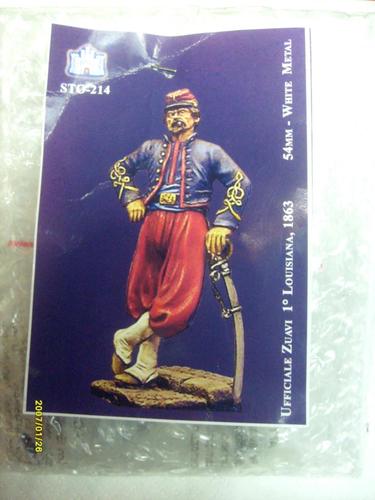 here were a number of Confederate Zouave units. In contrast to the many Federal units, most Confederate Zouaves were not full "regiments": many were companies within larger units. The cognomen "Louisiana Tiger" dates from the Mexican War, and refers to any Louisiana state trooper [and more recently, to the state's athletic teams]. But none of the Mexican War Louisiana "Tigers" were Zouaves. The earliest, and most famous Louisiana Zouave unit was r White's Company B (the "Tiger Rifles") of Major Chatham Roberdeau Wheat's First Special Battalion, Louisiana Volunteers, aka "Louisiana Tigers".
Winters notes too that a group of itinerant actors who claimed to have served in European wars stimulated the Zouave craze. The actors attracted large crowds and inspired the formation of military companies. They visited several New Orleans companies and instructed the men in a new manual of arms. They toured the river towns and played to an overflow audience in Plaquemine. In Alexandria in Central Louisiana,
 the actors performed "a bloody drama of the Crimean War."
In Alexandria in Central Louisiana, the actors performed "a bloody drama of the Crimean War."Among the Louisiana Zouaves were the "Louisiana Tigers" or "Coppen's Zouaves." These names have been confused with "Louisiana Tigers at Gettysburg." Coppen's Zouaves were at Gettysburg, but they were not then known as "Louisiana Tigers." Captain White's Company B, "Louisiana Tigers", of Major Wheats's First Special Battalion, were not at Gettysburg, having been disbanded after Wheat's death at Gaines Mill in 1862.
Friday, 24 February 2012
nardi rebel
tkQ1BPHTWtkSGQ~~60_12.jpg) I believe that this photo is not the property of a certain fucking old lady so here it is
I believe that this photo is not the property of a certain fucking old lady so here it isSunday, 11 September 2011

Tuesday, 6 September 2011
bypass of the civil war
 In 1861, the United States was torn apart by Civil War. Texas joined the rebelling States and provided both fighting men and vital supplies for the South.
This interactive video tours the Texas battlefields and brings to life the contributions and sacrifices that Texans made for the Confederacy, from the Union surrender in San Antonio, to cotton shipments across the Rio Grande, to the final battle of the Civil War at Palmetto Ranch.The impact of the Civil War on the civilian population of the Indian Territory was unparalleled in any other venue. Neither regular troops nor guerrilla bands on either side respected civilian property. Worse, bitter Removal-era hostilities within the Seminole, Cherokee, and Creek nations greatly escalated the level of violence aimed at perceived enemies, whether in uniform or not. To escape victimization, Indian Territory civilians on both sides fled their homes, creating a refugee problem not anticipated by Union or Confederate authorities.
Dislocation due to the war began in the summer of 1861 when the Creek Nation signed a treaty allying itself with the Confederacy. Opothleyahola, long-time foe of the pro-Confederate leaders, led dissident Creeks, with their movable wealth, slaves, and livestock, away to the western frontier. His followers included opponents of the Creek pro-Confederate faction, neutral Indians hoping to avoid war, and runaway slaves. When the dissidents' number reached about seven thousand, pro-Confederate leaders in the Indian nations became alarmed, fearing the loss of more slaves and that Opothleyahola and his "Loyalists" would join forces with Unionist troops to invade the Indian Territory.
As Opothleyahola led his followers toward the safety of Unionist Kansas, Confederate Indian and Texas troops launched a preemptive strike in November and December 1861. Opothleyahola's followers who survived the running fight to Kansas, now minus their belongings, found no preparations for their arrival. After a bitter winter of exposure and starvation, the able men enlisted in regiments of the Indian Home Guard. Federal authorities planned to use them in a summer invasion of the Indian Territory that they anticipated would allow the refugees to return home and provide for themselves. But the 1862 Indian Expedition failed, and one year after the war began, the Union agent reported that 5,487 refugees were still encamped at LeRoy, Kansas.
Meanwhile, federal employees, non-Indian residents, and missionaries who no longer felt safe in the Indian nations were leaving the Indian Territory in a more orderly fashion. Wealthy pro-Confederate Indians began a more substantial mass migration, taking their families, livestock, and male slaves to the Red River Valley of northern Texas, where they put land into production. Some, such as Creek Principal Chief Motey Kennard and Creek Judge George W. Stidham, then returned home to await events. But others, including Sarah Watie, wife of Confederate Cherokee commander Stand Watie, stayed, farming to support their children and slaves. With Opothleyahola in Kansas, early 1862 was relatively quiet for the pro-Confederate Indians, although "bushwhacking," or sporadic partisan attacks, took lives on both sides. The real fighting was generally far away in Missouri and Arkansas.
The calm lasted until the summer of 1862, when the Indian Expedition moved south from Kansas into the Cherokee Nation and set off a flight of pro-Confederate Cherokees. Some crossed the Arkansas River to settle temporarily in the Creek Nation and escape continuing violence in their own country, even after the invaders withdrew to Kansas. But in April 1863 a stronger, more determined Union advance began with the recapture of Fort Gibson. This time the invasion force included former slaves and Union Indians in federal uniforms, which particularly frightened pro-Confederate Cherokees and Creeks. More pro-Confederate Cherokees fled to the Red River Valley as these Union troops burned homes and harassed civilians as far south as Webbers Falls.
The final large-scale movement of refugees occurred in the aftermath of the Battle of Honey Springs on July 18, 1863. Pro-Confederate Cherokee and Creek civilians understood that the Confederate defeat and subsequent withdrawal south to the Canadian River left them exposed and vulnerable. They scrambled out of the way of the Union advance in a flight they later wryly called "the Stampede," taking refuge in the Red River Valley camps in the southern Choctaw and Chickasaw nations. For the last two years of the war the Creek Nation was virtually deserted.
In the Red River Valley Confederate Brig. Gen. Samuel Bell Maxey, ex-officio Superintendent of Indian Affairs, knew that the Indian families, many now destitute, must be cared for to ensure that their men would fight on in the Confederate Second Indian Cavalry Brigade. That unit was helping defend the Texas border. At various times Maxey supplied flour, beef, and soap to 4,823 Creeks in the Washita River camps, 2,906 Cherokees at Tishomingo, 574 Seminoles near Fort Washita, 241 Osages near Fort Arbuckle, 4,480 Choctaws, and 785 Chickasaws. However, the refugees helped themselves by growing abundant corn and vegetables. In 1864 they raised fifteen hundred bales of cotton to trade for textiles. Indian women carded cotton, spun yarn, and wove their own fabric to provide clothing for themselves and their men. Even so, there were chronic shortages of clothing and shoes. The capture of the million-dollar wagon train at the Second Battle of Cabin Creek on September 18, 1864, boosted morale by bringing welcome supplies of calico, candles, flour, bacon, coffee, canned goods, and shoes to the refugee camps.
By comparison, the Union refugees fared much worse. Although federal forces held Fort Gibson from April 1863 through 1865, the Confederate First Indian Cavalry Brigade raided the vicinity at will. Union Indian refugees, brought back from Kansas, dared not leave miserable, crowded camps protected by the fort's cannon. Federal troops rounded up slaves in the aftermath of Honey Springs and delivered them to the fort, adding further to the refugee problem. Feeding refugees who could not raise their own food was not a federal priority. Malnutrition then afflicted refugee camps already ravaged by smallpox, dysentery, pneumonia, diarrhea, and gastric disorders.
Refugees who survived four years of displacement, disease, and deprivation trickled home gratefully in late 1865 and 1866, but their number was drastically reduced. The toll of the dead or missing ranged from one of nine Chickasaws to one of every four Creeks. Once home, they faced the daunting task of rebuilding homes, farms, and public buildings that had been stripped, if not destroyed, in their absence.
Tuesday, 23 August 2011
ACW TEXAS
 RICK HALL the so called expert on the West last night said that Sergio Leone's film THE GOOD BAD AND UGLY was wrong as nothing happened in Texas as regards the civil war, wrong.There were not great battles but battles happened.
Tthe Union mounted several attempts to capture the Trans-Mississippi regions of Texas and Louisiana from 1862 until the war's end. With ports to the east under blockade or captured, Texas in particular became a blockade-running haven. Referred to as the "back door" of the Confederacy, Texas and western Louisiana continued to provide cotton crops that were transferred overland to the Mexican border town of Matamoros, Tamaulipas,
 and shipped to Europe in exchange for supplies. Determined to close this trade, the Union mounted several attacks, (below Foundry)each of them unsuccessful.
The U.S. Navy blockaded the principal seaport, Galveston, for four years, and Federal infantry occupied the city for three months in late 1862. Confederate troops under Gen. John B. Magruder recaptured the city on January 1, 1863 and it remained in Confederate hands until the end of the war.
The Battle of Galveston or the Second Battle of Galveston was a naval and land battle that occurred on January 1, 1863, during the American Civil War when Confederate forces under Maj. Gen. John B. Magruder attacked and expelled occupyingUnion troops from the city of Galveston, Texas.
The First Battle of Galveston was a naval engagement fought on October 4, 1862, during early Union attempts to blockade Galveston Harbor. A few days later the Confederate raider CSS Alabama attacked and sunk the USS Hatteras in a naval engagement off the coast of Galveston.
The Battle of Galveston or the Second Battle of Galveston was a naval and land battle that occurred on January 1, 1863, during the American Civil War when Confederate forces under Maj. Gen. John B. Magruder attacked and expelled occupyingUnion troops from the city of Galveston, Texas.
The First Battle of Galveston was a naval engagement fought on October 4, 1862, during early Union attempts to blockade Galveston Harbor.
A few days later the Confederate raider CSS Alabama attacked and sunk the USS Hatteras in a naval engagement off the coast of Galveston.
A few other cities also fell to Union troops at times during the war, including Port Lavaca(above and below), Indianola(below), and Brownsville. Federal attempts to seize control of Laredo, Corpus Christi, and Sabine Pass failed. By the end of the war no territory was in Union hands.
Indianola(below), and Brownsville. Federal attempts to seize control of Laredo, Corpus Christi, and Sabine Pass failed. By the end of the war no territory was in Union hands.
The most notable military battle in Texas during the war happened on September 8, 1863. At the Battle of Sabine Pass, a small garrison of 46 Confederates from the mostly-Irish Davis Guards under Lt. Richard W. Dowling, 1st Texas Heavy Artillery, defeated a much larger Union force from New Orleans under Gen. William B. Franklin.
Skilled gunnery by Dowling's troops disabled the lead ships in Franklin's flotilla, prompting the remainder—4,000 men on 27 ships—to retreat back to New Orleans. This victory against such overwhelming odds resulted in the Confederate Congress passing a special resolution of recognition and CSA President Jefferson Davis stating: "Sabine Pass will stand, perhaps for all time, as the greatest military victory in the history of the world."
a small garrison of 46 Confederates from the mostly-Irish Davis Guards under Lt. Richard W. Dowling, 1st Texas Heavy Artillery, defeated a much larger Union force from New Orleans under Gen. William B. Franklin. Skilled gunnery by Dowling's troops disabled the lead ships in Franklin's flotilla, prompting the remainder—4,000 men on 27 ships—to retreat back to New Orleans. This victory against such overwhelming odds resulted in the Confederate Congress passing a special resolution of recognition and CSA President Jefferson Davis stating: "Sabine Pass will stand, perhaps for all time, as the greatest military victory in the history of the world."
In 1864, many Texas forces, including a division under French Prince Camille de (above)PolignacPolignac was born in Millemont Seine-et-Oise, France, into one of the most famous families of the French nobility. His grandmother, Gabrielle, had been a famous aristocratic beauty and Queen Marie-Antoinette's closest friend. His father was Jules, prince de Polignac, who had been a passionate supporter of absolute monarchy and chief minister during the reign of KingCharles X of France, who trusted him implicitly and shared his political sympathies. Through his distant cousin, Pierre de Polignac, he was related to the Grimaldis of Monaco, a family who still rule that principality today.
into one of the most famous families of the French nobility. His grandmother, Gabrielle, had been a famous aristocratic beauty and Queen Marie-Antoinette's closest friend. His father was Jules, prince de Polignac, who had been a passionate supporter of absolute monarchy and chief minister during the reign of KingCharles X of France, who trusted him implicitly and shared his political sympathies. Through his distant cousin, Pierre de Polignac, he was related to the Grimaldis of Monaco, a family who still rule that principality today.
Polignac studied mathematics and music at St. Stanislas College in the 1840s. In 1853 he joined the French army. He served in the Crimean War from 1854 to 1855, receiving a commission as a second lieutenant. He resigned from the army in 1859 and traveled to Central America to study geography and political economy, as well as the native plant life. He then visited the United States in the early 1860s.) moved into Northwestern Louisiana to stall Union Maj. Gen. Nathaniel Banks' Red River Campaign, which was intended to advance into Texas from its eastern border. Confederate forces halted the expedition at the Battle of Mansfield, just east of the Texas border.
The last battle of the Civil War, the Battle of Palmito Ranch, was fought in Texas on May 12, 1865, well after Robert E. Lee's surrender on April 9, 1865, at Old Appomattox Court House,Virginia.
In the spring of 1865, Texas contained over 60,000 soldiers of the Army of the Trans-Mississippi under Gen. Edmund Kirby Smith. As garrison troops far removed from the main theaters of the war, morale had deteriorated to the point of frequent desertion and thievery.  News of the surrender of Lee and other Confederate generals east of the Mississippi finally reached Texas around April 20. Local Confederate authorities had mixed opinions on their future course of action. Most senior military leaders vowed to press on with the war, including commanding general Kirby Smith. Many soldiers, however, greeted frequent speeches whose theme was "fight on, boys" with derision, or simply failed to attend them.
News of the surrender of Lee and other Confederate generals east of the Mississippi finally reached Texas around April 20. Local Confederate authorities had mixed opinions on their future course of action. Most senior military leaders vowed to press on with the war, including commanding general Kirby Smith. Many soldiers, however, greeted frequent speeches whose theme was "fight on, boys" with derision, or simply failed to attend them.
The month of May brought increasing rates of desertion. News of Joseph E. Johnston's and Richard Taylor's surrenders confirmed that Texas, Louisiana, and Arkansas were now essentially alone to continue the Confederate cause. On May 14, troops in Galveston briefly mutinied, but were persuaded to remain under arms. However, morale continued to sink. Generals John B. Magruder and Kirby Smith (who had already corresponded with Union Maj. Gen. John Pope regarding surrender terms on May 9) no longer sought to rally their demoralized troops, but rather began discussing the distribution of Confederate government property. Magruder pled that the rapid disbanding of the army would prevent depradations by disgruntled soldiers against the civilian population
On May 14, troops in Galveston briefly mutinied, but were persuaded to remain under arms. However, morale continued to sink. Generals John B. Magruder and Kirby Smith (who had already corresponded with Union Maj. Gen. John Pope regarding surrender terms on May 9) no longer sought to rally their demoralized troops, but rather began discussing the distribution of Confederate government property. Magruder pled that the rapid disbanding of the army would prevent depradations by disgruntled soldiers against the civilian population
The haste to disband the army, combined with the pressing need to protect Confederate property from Union confiscation, created general mayhem. Soldiers began openly pillaging the Galveston quartermasters stores on May 21.

Over the next few days, a mob demanded that a government warehouse be opened to them, and soldiers detained and plundered a train. Several hundred civilians sacked the blockade runner Lark when it docked on May 24, and troops sent to pacify the crowd soon joined in the plunder. On May 23, residents in Houston sacked the ordnance building and the clothing bureau. Riots continued in the city until May 26. Both government and private stores were raided extensively in Tyler, Marshall, Huntsville, Gonzales, Hempstead, La Grange, and Brownsville. In Navasota, a powder explosion cost eight lives and flattened twenty buildings. In Austin, the state treasury was raided and $17,000 in gold was stolen. By May 27, half of the original Confederate forces in Texas had deserted or been disbanded, and formal order had disappeared into lawlessness in many areas of Texas.(below 1st Texas )

Over the next few days, a mob demanded that a government warehouse be opened to them, and soldiers detained and plundered a train. Several hundred civilians sacked the blockade runner Lark when it docked on May 24, and troops sent to pacify the crowd soon joined in the plunder. On May 23, residents in Houston sacked the ordnance building and the clothing bureau. Riots continued in the city until May 26. Both government and private stores were raided extensively in Tyler, Marshall, Huntsville, Gonzales, Hempstead, La Grange, and Brownsville. In Navasota, a powder explosion cost eight lives and flattened twenty buildings. In Austin, the state treasury was raided and $17,000 in gold was stolen. By May 27, half of the original Confederate forces in Texas had deserted or been disbanded, and formal order had disappeared into lawlessness in many areas of Texas.(below 1st Texas )
The formal remnants of Kirby Smith's army had finally disintegrated by the end of May. Upon his arrival in Houston from Shreveport , the general called a court of inquiry to investigate the "causes and manner of the disbandment of the troops in the District of Texas, New Mexico and Arizona." The May 30 findings laid the blame primarily on the civilian population. Kirby Smith addressed his few remaining soldiers and condemned those that had fled for not struggling to the last and leaving him "a commander without an army– a General without troops." On June 2, he formally surrendered what was left of the Army of the Trans-Mississippi.

, the general called a court of inquiry to investigate the "causes and manner of the disbandment of the troops in the District of Texas, New Mexico and Arizona." The May 30 findings laid the blame primarily on the civilian population. Kirby Smith addressed his few remaining soldiers and condemned those that had fled for not struggling to the last and leaving him "a commander without an army– a General without troops." On June 2, he formally surrendered what was left of the Army of the Trans-Mississippi.
Federal troops did not arrive in Texas to restore order until June 19, 1865, when Union Maj. Gen. Gordon Granger and 2,000 Union soldiers arrived on Galveston Island
 to take possession of the state and enforce slaves’ new freedoms.
The Texas holiday Juneteenth commemorates this date. The Stars and Stripes were not raised over Austin until June 25.

Union Maj. Gen. Gordon Granger and 2,000 Union soldiers arrived on Galveston Island to take possession of the state and enforce slaves’ new freedoms.The Texas holiday Juneteenth commemorates this date. The Stars and Stripes were not raised over Austin until June 25.
President Andrew Johnson appointed Union General Andrew J. Hamilton, a prominent politician before the war, as the provisional governor on June 17. He granted amnesty to ex-Confederates if they promised to support the Union in the future, appointing some to office. However, it was not until March 30, 1870, that the United States Congress permitted Texas' representatives to take their seat in Congress, although Texas did not meet all the formal requirements for readmission.

Saturday, 21 May 2011

Monday, 6 October 2008

Subscribe to:
Posts (Atom)